
Do We Need A Bauhaus for Generative Social Fields?
source / credit
Published in MEDIUM magazine by Otto Scharmer | November 9, 2026
Why higher education needs a fourth founding in the age of AI
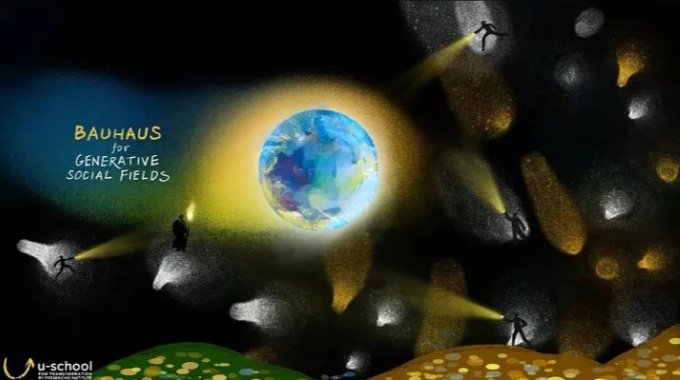
This fall, in the residential u-lab course I teach at MIT Sloan, with graduate and mid-career students from across MIT and Harvard in the room, one of our circle dialogues turned to the present moment. A student summarized what many had said before:
“We run from one class to the next; we are all stressed; we use AI for all our homework assignments; I know it’s not good — but, you know, I am just trying to survive. We know that knowledge is no longer the main part. It’s the connections that we will take from here. So we spend time together. But when we do, we do not have these deeper relationships that we have here in this class. In all these other places, it’s just socializing…”
[…]
Let us zoom out and put this snapshot into context. We all, and especially the current student generation, live in a moment where AI is hacking the human condition in three waves: the first wave went after our attention (attention fracking through social media algorithms); the second after our attachment, our relationships (companion chatbots); and the third is going after our agency (agentic AI).
[…]
The visible side effects of these three waves can be summed up in a single word: atrophy, the loss of a capacity through disuse. Capacities we do not use shrink, and at some point they vanish. Atrophy happens on all three levels. We see it cognitively: shortening attention spans and what an MIT Media Lab study called “cognitive debt.” We see it relationally: loneliness, and what Sherry Turkle calls “artificial intimacy.” And we see it creatively: what MIT’s report on AI and education calls “cognitive surrender.”